



The short answer
You need a website for your business if customers look you up before they ring. A DIY site starts at about £9 a month plus VAT, billed annually. Social media and a Google Business Profile help, but a website is the one place online you control. If all your work comes from a few regulars, you can skip it.
Find out what is costing your site enquiries Run the free instant website check →
Do I really need a website for my small business?
A website is not a legal requirement, and it will not bring in work on its own. Its job is narrower: it is where people check you out once they have heard your name.
Think about how work reaches you. A neighbour recommends you. Someone sees your van. A customer finds you on the map or on Instagram. In our experience, most of those people look you up before they pick up the phone. What they find decides whether they call you or the next name on the list.
So a more useful question is this: "when someone looks me up, what do they find, and does it make them want to call?" If the honest answer is “nothing”, or “a Facebook page I last posted on two years ago”, a small, clear website is usually worth having.
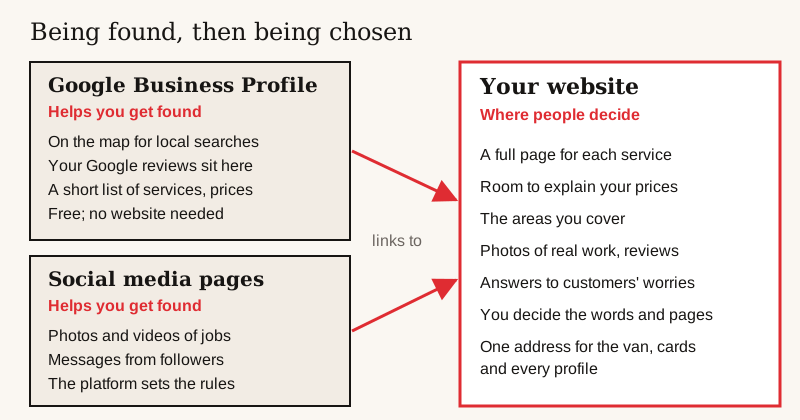
It helps to separate two jobs: being found, and being chosen. Profiles and listings are good at the first. A website is usually better at the second, because it has room to show your work, set expectations on price and answer the doubts that stop people ringing.
Facebook vs a website for a small business: what is the difference?
Most owners already have at least one of these. Each does a different job, and the main difference between them is who is in charge.
Your own website compared with the main alternatives
Your own website
- Who controls it
- You decide the words, pages and address. Some builders (Wix, for one) only run your site on their own servers.
- What it costs you
- A DIY builder from about £9 a month plus VAT, billed annually, plus your time. A designed site costs more up front.
- Good at
- Explaining your services, prices, areas and proof in full. One address for the van, cards and every profile.
- Weak at
- A new site starts with no visitors, and it needs keeping up to date.
Facebook, Instagram or TikTok
- Who controls it
- The platform sets the layout, the rules and who sees your posts. Meta runs Facebook and Instagram.
- What it costs you
- Your time to set up and keep posting. Adverts are extra.
- Good at
- Photos, short videos of jobs, updates and messages from people who already follow you.
- Weak at
- You cannot change how the page looks. Some customers do not use that app, and older posts are hard to find.
Google Business Profile
- Who controls it
- Google decides when and where you appear. You supply the details.
- What it costs you
- Your time to set up and keep accurate.
- Good at
- Showing on the map for local searches, alongside your reviews.
- Weak at
- Little room to explain your work. Google decides when you are a good match.
Checkatrade-style listing
- Who controls it
- The platform: its rules, its ranking, its page design.
- What it costs you
- Depends on the platform. Read its current terms before you sign.
- Good at
- Borrowed trust, and an audience already looking for a trade.
- Weak at
- You sit next to competitors, on their site, under their terms.
| Option | Who controls it | What it costs you | Good at | Weak at |
|---|---|---|---|---|
| Your own website | You decide the words, pages and address. Some builders (Wix, for one) only run your site on their own servers. | A DIY builder from about £9 a month plus VAT, billed annually, plus your time. A designed site costs more up front. | Explaining your services, prices, areas and proof in full. One address for the van, cards and every profile. | A new site starts with no visitors, and it needs keeping up to date. |
| Facebook, Instagram or TikTok | The platform sets the layout, the rules and who sees your posts. Meta runs Facebook and Instagram. | Your time to set up and keep posting. Adverts are extra. | Photos, short videos of jobs, updates and messages from people who already follow you. | You cannot change how the page looks. Some customers do not use that app, and older posts are hard to find. |
| Google Business Profile | Google decides when and where you appear. You supply the details. | Your time to set up and keep accurate. | Showing on the map for local searches, alongside your reviews. | Little room to explain your work. Google decides when you are a good match. |
| Checkatrade-style listing | The platform: its rules, its ranking, its page design. | Depends on the platform. Read its current terms before you sign. | Borrowed trust, and an audience already looking for a trade. | You sit next to competitors, on their site, under their terms. |
Every option except the website is rented space. That is fine, and often useful: an Instagram or TikTok account full of finished jobs is good proof. But if a platform changes its rules, fees or layout, you have no say. A website is the one piece you own, and the others work better when they point to it, with your web address in every bio.
Ownership depends on how the site is built and who built it. Our guide to who owns your website explains how to check.
Is a Google Business Profile enough without a website?
For many local searches, your Google Business Profile is the first thing people see. If you only do one thing this week, set up your profile properly.
Google says local results are mainly based on three things: relevance (how well your profile matches the search), distance (how far you are from the person searching) and prominence, which its page also calls popularity (how well known you are). Prominence draws on information such as how many websites link to your business and how many reviews you have. Google also says there is no way to request or pay for a better local ranking. Our guides to how Google Business Profiles work and local SEO basics go further.
A profile can list your services, and Google’s services help says you can add a description and a price to each. What it does not give you is room or control. Google sets the layout, and a short entry per service is not a page that shows that job in photos, explains what affects the price and answers the worries that stop people ringing. The profile gets you noticed. The website is where they decide.
Do I need a website for Google reviews, Google Ads or a Business Profile?
Not for a profile or for reviews. For most Google Ads, yes. Google’s own help pages answer each part:
- A Business Profile: no website needed. Google Ads Help says "Businesses without a website can verify their business with Business Profile". The sign-up steps ask for your name, category, location or service area, phone number and website address, and the profile editing page describes a website as something you “can share”. Listing on Google is free.
- Google reviews: no website needed. Reviews sit on your Business Profile. Google’s tips to get more reviews suggest asking customers to “visit a Google link or scan a QR code”, and say customers must be signed in to a Google Account to leave one. Google also says offering incentives for reviews “is strictly prohibited”.
- Google Ads: usually yes. Google defines the final URL as "the URL address of the web page in your website that people reach after they click your ad", also known as the landing page, and you set one for each ad you create. The exception Google names is that businesses without a website can advertise with Smart campaigns, using their Business Profile.
So the free parts of Google work without a website. The website earns its place one step later: someone reads your reviews, then taps through to see your work, your prices and the areas you cover. And if you pay for adverts, the page people land on decides whether the click turns into a call.
★★★★★
“… He took the vision for my brand, Byte & Batter, and built a premium, high-converting digital storefront entirely from scratch. …”
Is it still worth having a website, now people use AI search?
More people now ask ChatGPT, Google’s AI answers or a voice assistant for a recommendation, which has led some owners to wonder whether websites are necessary any more.
Those tools can only use what they can find. Google finds pages by following links and reading sitemaps. If your services, areas and prices are written clearly on your own site, there is something accurate to find. If the only trace of you is a few social posts, there is much less.
What helps is simple: services written out as words that can be read, with nothing important locked inside a photo; the areas you cover named; accreditations in plain text; and the same name, address and phone number on your site and every profile.
What is the minimum website a small business needs?
Most small service businesses can do a lot with a handful of pages. If you are starting from nothing, this is the list we would work to:
- What you do and where, in the first screen, in plain words. “Boiler repairs and servicing in Stockport” beats “Welcome to our website”.
- One page per main service, so a customer looking for that job finds a page about that job.
- Proof: photos of real work and real reviews. Never stock photos passed off as your own.
- A rough idea of price, even a “from” figure, so the right customers call and the wrong ones do not.
- One obvious way to get in touch that works on a phone: a number that dials with one tap and a short form.
- An email address on your own domain, such as info@yourbusiness.co.uk, rather than a Gmail or Hotmail address. It looks established on a quote or a van, and it stays yours if you change email provider. Owning the domain is the first step to both this and a website.
- The places you cover, written out in words as well as shown on a map.
- Your legal details. A limited company’s website must show its registered number, its registered office address, where it is registered (England and Wales, Scotland or Northern Ireland) and that it is a limited company, usually through its full name with “Limited” or “Ltd”. GOV.UK lists all four. Privacy information, for any business, sole traders included: if the site collects personal details, for example through a contact form, the ICO says you must give people privacy information at the time you collect their data. A privacy notice on the site does that, and the ICO has a free tool to create one.
Then put the address everywhere: your Google profile, your van, your cards, your quotes. Google’s own starter guide suggests listing your site’s address on business cards, letterheads and posters.
What does a small business website cost over three years?
Costs range from about £9 a month plus VAT for a DIY builder to several thousand pounds for an agency build. Our guide to website costs breaks down every line, and what web designers charge in the UK covers paying someone to build it. But the real question is which site wins the job when a customer has your name and two others open on their phone.
A DIY site can win that comparison if you have the time and the knack: clear words, real photos, prices and a number that dials with one tap. Where DIY sites tend to lose, in our experience, is the words: they describe the business and leave the customer’s worries unanswered.
Coltura's fixed-price build is the Growth Website, £1,400, which you own. That includes working out how to explain your business and writing the copy, as well as the design and build. It takes about 14 working days of build once we have agreed the direction and you have got us your content.
Example only: three years of having a website, three ways (outside prices ex VAT)
DIY builder (Wix Light, billed annually, ex VAT)
- How the sum works
- £9 x 36 months + £15.98 for the same .co.uk in years 2 and 3 (the first year's domain is free on annual billing)
- Three-year total
- £339.98 plus VAT, plus your time
Coltura build, hosted yourself
- How the sum works
- £1,400 build + £216 basic hosting (IONOS Standard at its regular £6 a month, ignoring the introductory offer) + £23.97 for a .co.uk domain (Krystal, £7.99 a year)
- Three-year total
- £1,639.97, plus VAT on hosting and domain
Coltura build with Growth Care
- How the sum works
- £1,400 build + £149 x 36 months (£5,364) + £23.97 for the same .co.uk domain
- Three-year total
- £6,787.97
| Route | How the sum works | Three-year total |
|---|---|---|
| DIY builder (Wix Light, billed annually, ex VAT) | £9 x 36 months + £15.98 for the same .co.uk in years 2 and 3 (the first year's domain is free on annual billing) | £339.98 plus VAT, plus your time |
| Coltura build, hosted yourself | £1,400 build + £216 basic hosting (IONOS Standard at its regular £6 a month, ignoring the introductory offer) + £23.97 for a .co.uk domain (Krystal, £7.99 a year) | £1,639.97, plus VAT on hosting and domain |
| Coltura build with Growth Care | £1,400 build + £149 x 36 months (£5,364) + £23.97 for the same .co.uk domain | £6,787.97 |
- DIY builder (Wix Light)£339.98 + VAT
- Coltura build, hosted yourself£1,639.97
- Coltura build with Growth Care£6,787.97
Outside prices (Wix, IONOS hosting, Krystal domain) are before VAT, as in the table. The DIY total leaves out your time.
An illustration only. Say an average job leaves you £300 profit. On the figures in the table, the self-hosted Coltura row costs £1,299.99 more than the DIY row over three years (£1,639.97 minus £339.98). That is about 5 jobs over three years, before counting the hours a DIY site takes. If you doubt a clearer site would win 5 jobs you are losing now, choose the DIY row.
The bottom two rows are the same website; the difference is who looks after it. Growth Care covers hosting, security, backups, monitoring and content changes within a fair monthly allowance. At £149 a month it costs more than a cheap DIY plan or many pay-monthly websites, and it is optional: cancel any time, with a month's notice. If you are happy to look after hosting yourself, the self-hosted row is a real choice. Our guide on whether you have to pay monthly for a website sets out the trade-offs, and what a website costs to run each year lists hosting, domain and email prices.
When does a small business not need a website?
Sometimes the honest answer is no, or not yet. You can probably skip a website, or put it off, if:
- All your work comes from one main contractor or a handful of long-standing customers, and you are not trying to change that.
- You are fully booked months ahead and happy with your prices.
- You are testing an idea. A good Google Business Profile, or a listing site, can be a simpler first step.
- You will not keep it up to date. An abandoned site with old prices and a dead phone number can do more harm than none.
If you want more or better-paid work from people who have never met you, a website usually earns its place. If you have one but it does not appear when people search your name, start with why a website is not showing on Google. If you are unsure whether to fix it or start again, see website redesign vs new website. If it brings in no enquiries, the problem may be the site rather than the idea. A free Growth Audit gives you a written, prioritised list of what is costing you enquiries and what we would do about it, whether or not you go ahead. You can also see sites we have built for other small businesses.
Google reviews
What clients say
★★★★★
“A rare mix of technical depth, commercial clarity, and design awareness. Adam brings a fresh, intuitive approach to web development with an exceptional grasp of the technology, and the patience to guide you through it.”
★★★★★
“He took the vision for my brand, Byte & Batter, and built a premium, high-converting digital storefront entirely from scratch.”
Quoted word for word from Coltura's Google Business Profile. See the sites behind them on the work page.
FAQ
Common questions
Is a Facebook page enough for a small business?
It helps with people who already follow you, but the platform decides who sees your posts and how your page looks, and some customers do not use that app. Use it alongside a website you control, with your web address in the bio.
Do I need a website if I have a Google Business Profile?
You can have a profile without one, but most service businesses benefit from both. The profile puts you on the map with your reviews and a short list of services; the website has room to explain each service, show your work and answer a customer’s worries. The profile gets you noticed; the website is where people decide, so link the two.
Can I get a website for free?
Yes, with limits. Wix says creating a website is free, but a free site sits on an address like username.wixsite.com/sitename, and you need a paid plan to use your own domain and remove Wix branding. A Google Business Profile is free, and a sensible free first step.
Do I need a website as a sole trader?
GOV.UK does not list one. Its guide to sole trader responsibilities covers your business name, keeping records, registering for Self Assessment and tax, and says you can start trading straight away without registering. Whether you need one depends on whether customers look you up before they ring, as for any business.
Does my website need a privacy policy?
If it collects personal details, such as a contact form asking for a name and phone number, yes. The ICO says "You must provide privacy information to individuals at the time you collect their personal data from them", and it has a free tool to create your own privacy notice. The ICO notes its guidance is under review after the Data (Use and Access) Act.
Can I just use Checkatrade instead of a website?
A listing site can bring in work and lend you trust, but your profile sits next to competitors and lives under the platform’s terms. Many trades use both, with the listing pointing to their own site.
Do tradespeople and cleaners need a website?
The same test applies to builders, contractors, cleaners and every other trade: if customers look you up before they ring, a small website with your services, the areas you cover, photos of real work and a number that dials with one tap usually earns its place. If your work comes from one main contractor or a few regulars, you may not need one yet.
Do I need a website if I get work by word of mouth?
Often, yes. In our experience, people who are recommended to you still look you up before they ring, and what they find decides whether they call. If you are booked well ahead and happy with your prices, you may not need one yet.
Do I need a website to have a business email address?
A domain is all you need. Once you own yourbusiness.co.uk you can set up email on it with an email provider, and the same domain can carry a website later.
Is a one-page website enough?
For a business with one service in one area, often yes. Once you offer several services or cover several places, a page for each usually helps customers find the bit they need.
Read next
Sources
- ExpertSure: Wix pricing UK (Wix Light £9 a month billed annually (prices verified Aug 2026; page re-opened 19 Oct 2026, figure unchanged))
- Wix: premium plans ("Prices do not include applicable taxes"; free site on a username.wixsite.com address; paid plan to connect your own domain and remove Wix branding)
- Google Business Profile ("creating a Business Profile and listing your business on Google is free")
- Wix Help Center: exporting or embedding your Wix site elsewhere (Wix sites are hosted on Wix’s servers)
- Google Business Profile Help: tips to improve your local ranking (Relevance, distance and prominence (“popularity” in the page opening); links and reviews; no paying for a better local ranking)
- Google Search Central: how Google Search works (Google finds pages through links and sitemaps)
- Google Search Central: SEO starter guide (List your site address on business cards, letterhead and posters)
- IONOS web hosting (Standard plan £3 a month for 6 months then £6, ex VAT)
- Krystal domain names (.co.uk £7.99 a year to register and renew, ex VAT)
- GOV.UK: running a limited company, signs and stationery (Registered number, registered office address, where registered, and that it is a limited company)
- Google Ads Help: Business Profile definition ("Businesses without a website can verify their business with Business Profile and advertise with Smart campaigns")
- Google Business Profile Help: manage your services (Services can carry a description and a price, grouped into categories)
- Google Business Profile Help: sign up for Business Profile (Sign-up steps: name, category, location or service area, phone number and website URL)
- Google Business Profile Help: edit your Business Profile ("You can share your business’s website with your customers on your Business Profile")
- Google Business Profile Help: tips to get more reviews (Ask customers to “visit a Google link or scan a QR code”; signed-in Google Account needed; incentives "strictly prohibited")
- Google Ads Help: final URL definition (The final URL is the landing page people reach after clicking your ad; you specify one for each ad)
- GOV.UK: set up as a sole trader (Sole trader responsibilities; "You can start trading straight away without registering")
- ICO: the right to be informed ("You must provide privacy information to individuals at the time you collect their personal data from them")
- ICO: create your own privacy notice (Free privacy notice generator; guidance under review after the Data (Use and Access) Act)
Outside prices were checked in October 2026 (Wix: ExpertSure, August 2026) and change often; check the provider before you buy. Industry price ranges are the firms' own published estimates.