



Websites for dental practices
Dental practice websites that make the NHS and private picture clear
A lot of calls to a dental reception start with the same question: are you taking NHS patients? Many of the rest come from private patients weighing up implants, aligners or whitening, who want far more detail than most practice websites give them. A good dental site answers both before the phone rings.
- Price from
- £1,400
- Build time
- 14 working days
- Built by
- Coltura
- Growth Care™
- £149 a month
One-off, for a Growth Website of up to 6 pages.
From agreed direction to launch.
Our studio in Didsbury, Manchester.
Optional. Cancel any time, with a month’s notice.
How your customers choose
Toothache is decided this morning. Implants are decided over months.
A practice website serves three different visitors: someone in pain who needs to be seen today, a family looking for a new practice, and someone weighing up private treatment worth thousands. Each needs a different first answer, and most practice sites give all three the same homepage.
When it is urgent
In pain, and needing to be seen today
They search on a phone, often early in the morning, and want to know whether you see people who are not already your patients, how to get a same-day slot, what an emergency appointment costs and what to do out of hours: NHS 111 in England and Wales, or NHS 24 on 111 in Scotland. A clear emergency page gives them an answer and gives reception a script.
When it is considered
Private treatment, or a new practice for the family
Both are slow decisions. People compare practices on fees, on the team, on how nervous patients are treated and on what other patients say, and they often read for weeks before they book a consultation or register.
What wins their trust, what loses it, and what they search for
What makes them trust you
- Photos of the real practice: reception, surgery and team
- A plain account of how nervous patients are looked after
- Reviews that mention a dentist by name and a treatment
- Parking, access and opening hours that are easy to find
What makes them leave
- An NHS status that is months out of date
- Treatment pages that never say what the consultation costs
- Having to ring reception to ask a simple question
- A team page nobody has touched since people left
What they type into Google
- “emergency dentist near me”
- “NHS dentist taking new patients”
- “dentist near me”
- “dental implants cost”
- “invisible braces cost”
- “teeth whitening”
- “composite bonding”
- “nervous patient dentist”
Patients type the problem or the treatment rather than the clinical term: a broken tooth rather than a fractured crown, invisible braces rather than clear aligners. Pages written in their words, with the clinical term alongside, match the search and still read as expert.
01 / 04
NHS, private or mixed: say which on the first screen
People looking for an NHS dentist are often ringing round every practice in the area. If you are not currently accepting new NHS patients, say so plainly, with the date it was last checked and what you can offer instead. That spares reception a stream of calls and spares the patient a wasted afternoon. If you are accepting new NHS patients, say that just as clearly, because it is exactly what many people are searching for.
Read moreShow less
Mixed practices gain most from clarity: which treatments are available on the NHS, which are private only, and whether there is a membership plan for routine care. This is also the part of the site most likely to go out of date, since it changes every time your capacity does.
02 / 04
Implants, aligners and bonding: treatments people research for weeks
Private treatments with a large fee are researched slowly. A single cosmetic dentistry page with a stock smile helps nobody deciding on implants. Each major treatment needs its own page: who it suits, the stages involved, how many appointments, how long the whole process takes, what the consultation costs and what happens if it turns out not to be suitable.
Read moreShow less
Before and after photos need the patient's consent and should be genuine, unretouched cases from your own practice. Brand names such as Invisalign come with the manufacturer's own rules on how they may be used, so check your provider terms before building a page around one.
03 / 04
Private work, paid search and a site that stays accurate
For a practice with a full NHS list, the website's commercial job is mostly private work. Your Google Business Profile, with the right categories, photos of the practice and recent reviews, handles people searching for a dentist nearby. Treatment searches, such as dental implants or composite bonding with a town name, are where dedicated pages and sometimes paid search come in.
Read moreShow less
Paid search for implants and aligners is competitive, and only makes sense with a landing page for that treatment, a clear consultation price and tracking on the consultations it books. Adverts fall under the same CAP rules as the website. Growth Care keeps fees, team details and NHS status current as they change, which in dentistry is often.
04 / 04
Facial aesthetics on a dental website
Many practices offer anti-wrinkle treatment and fillers alongside dentistry. Botulinum toxin is a prescription-only medicine, and prescription-only medicines cannot be advertised to the public in the UK. The ASA has taken action on this repeatedly, across websites and social media.
Read moreShow less
The workable approach is a page about facial aesthetics consultations that does not promote the medicine: what the consultation involves, who carries it out and their qualifications. CAP's guidance here is specific, down to which phrases are treated as promoting the medicine, so read it before writing a line. Fillers are not prescription-only medicines, but claims about what they achieve still have to be accurate.
What the website needs
The dental practice site, page by page
Three routes from the first screen: emergencies, new patients and private treatment. Behind them sit the details GDC guidance requires and the pages patients actually read.
Homepage. NHS, private or mixed in one line, opening hours, an emergency route and a way to book or register.
Emergency appointments. Who you can see today and how, what it costs, and the out-of-hours number.
New patients. Whether you are currently accepting new NHS patients, private registration, any membership plan and how to join.
A page per major treatment. Implants, aligners, whitening and bonding, each with its consultation fee and a way to book one.
Fees. Starting prices for common treatments, NHS charges if you offer NHS care, and finance wording exactly as your provider supplies it.
The team. Each dental professional with the details GDC guidance requires, and the treatments they carry out.
The enquiry route, and what to leave out
The enquiry route
From “I need a dentist” to a booked appointment
- The first screen splits three ways: emergency, new patient or private treatment.
- Emergencies go to a tap-to-call number and the same-day process.
- New patients see whether you are accepting NHS patients before they ring, and how to join.
- Private treatment goes to a consultation request that asks which treatment and when they would like to come in.
Leave it out
What not to put on the site
- Stock photos of smiles that are not your patients
- A slider of offers sitting above the emergency number
- Treatment prices from before the last increase
- Staff who have since left the practice
Proof and credentials
The rules that decide what a practice website can say
Dentistry is regulated, and so is how it is advertised. Getting this right reassures patients and keeps the practice out of trouble. The rules on promoting facial aesthetics are covered above; these are the others.
What to show, item by item
- GDC guidance on advertising
- The GDC's guidance says a practice website must show each dental professional's name, qualification and the country it was gained in, and their GDC registration number. It must also show the practice address and contact details, a link to the GDC, the complaints procedure with where to go next, and the date the site was last updated.
- Specialist titles
- Only dentists on a GDC specialist list may be described as specialists. Implant dentistry is not a GDC specialty, so a dentist with extra training in implants can say so, without the title.
- CQC registration in England
- Dental practices in England are registered with the Care Quality Commission, and linking to your CQC page lets patients check you for themselves. The other nations have their own regulators (Healthcare Improvement Scotland, Healthcare Inspectorate Wales and the RQIA in Northern Ireland), each with its own rules on which practices it registers. In Scotland, for example, it registers private-only clinics. If yours has a page for you, link to it.
- Finance
- If you introduce patients to a finance provider, the practice is acting as a credit broker. It needs its own FCA permission, or to be formally appointed as a representative of a firm that holds one. Use exactly the wording and representative example your finance provider supplies.
 Fictional business
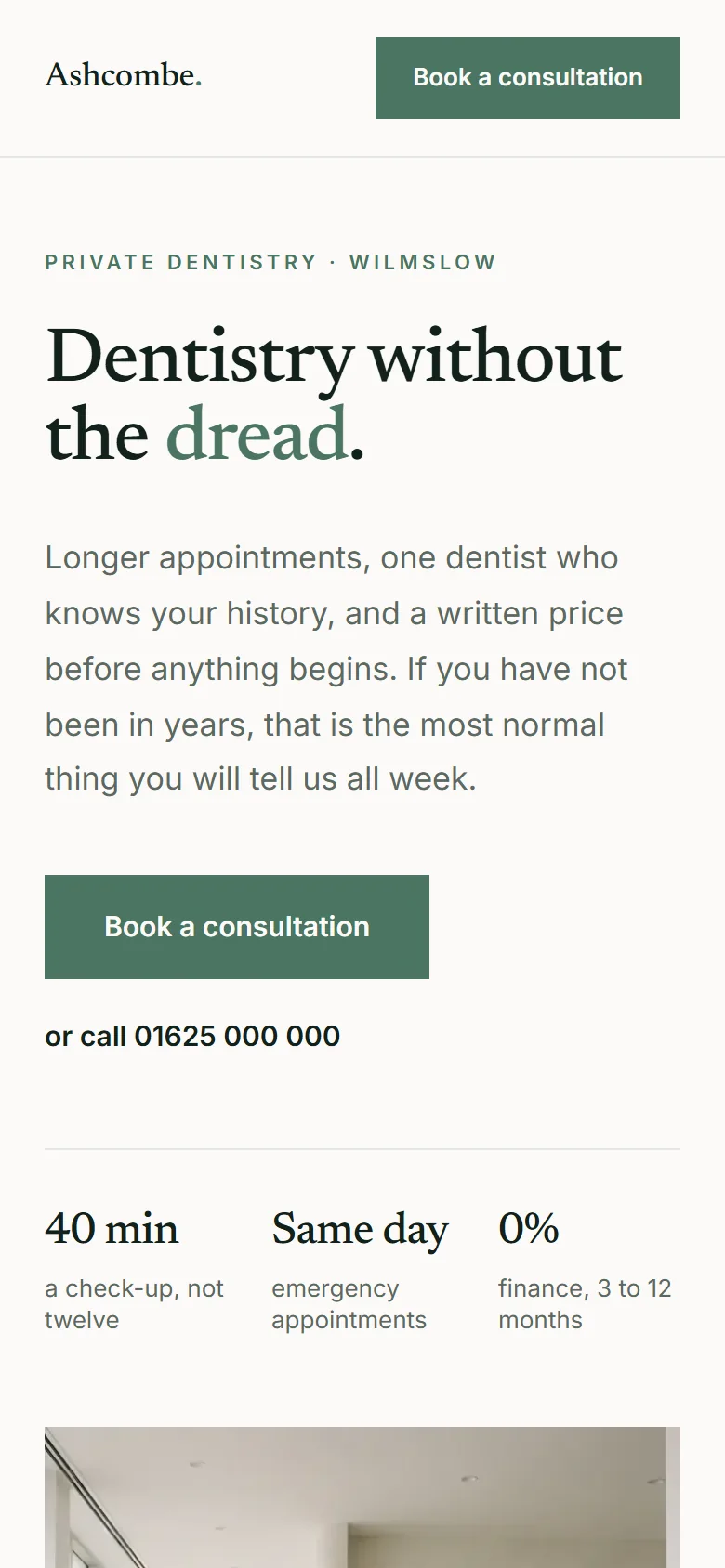
Demonstration design
See a dental practice site built this way.
Ashcombe Dental is a demonstration design for a fictional dental practice. The business does not exist, and it is not a Coltura client.
Look at how it states fees plainly instead of “prices from”, answers the nervous-patient question before anyone has to ask it, and explains what happens in an emergency.
In our clients’ words
What our clients say.
Questions
The questions dental clinics ask.
Is it wise to put private dental fees on the website?
Yes, at least starting prices for common treatments and the cost of a consultation. Patients considering implants or aligners compare practices carefully, and a practice that shows its fees and explains what is included looks more trustworthy than one that asks them to call.
Can patients book appointments online?
If your practice software offers online booking, the site can link straight to it, usually for check-ups and hygiene appointments with existing patients. New patients and private consultations often work better through a short form, so reception can check the details first. Either way, the site makes the route obvious.
Do we need a separate website for facial aesthetics?
Usually not. A page on the practice site, written around the consultation, keeps your reviews and search visibility in one place and reassures patients who already trust you. A separate site makes sense only when the aesthetics side runs as a genuinely separate business with its own clinicians.
The offer in brief
Five answers that are the same for every business we build for. Open any of them.
What does it cost, and what is included?
Growth Websites start at £1,400, one-off, for a complete rebuild of up to 6 pages with setup included. A larger site is the Signature Website, at £3,500. Up to six pages, which for a dental practice usually means a homepage with the three routes, an emergency page, a new patients page, a treatments page, a fees page and a team page with the details GDC guidance requires. You also get your Google Business Profile set up and linked, and tracking of the consultations the site brings in. A bigger site with more pages is the Signature Website, which can give each major private treatment its own page.
All nine parts are included:
- Growth Audit
- Offer and Messaging Rebuild
- Complete Website Rebuild
- Conversion Optimisation
- Local Search Foundation
- AI Search Readiness
- Conversion Tracking
- Performance Optimisation
- Launch Support
How long does it take, and what do you need from me?
About 14 working days from agreed direction to launch. You watch the real site take shape on a private link, with one round of considered changes before launch. What we need from you: your current fees, your NHS and private status, the team with their qualifications and GDC numbers, the treatments you want more of, and any finance wording your provider supplies. Beyond that, about half an hour on the phone; we write the copy.
Who builds it?
Coltura, an independent digital studio in Didsbury, Manchester. We do every audit and every build in-house, so you deal directly with the studio doing the work. We take on a limited number of builds at once, which is why there is sometimes a short wait before a build starts.
Do I have to pay every month?
No. Growth Care is £149 a month if you want it, and entirely optional. It covers hosting and security, monitoring, content changes within a fair monthly allowance, a plain-English monthly report, a quarterly conversion review and messaging us directly. Cancel any time, with a month's notice. You are also free to host the site yourself.
What if it is not right for us?
The audit and the direction come before you commit. If the plan is the wrong fit for your business, you can walk away and keep the audit. You own the site, the domain and the content outright, and after launch anything that does not work the way it was built to work is fixed at no charge for 30 days.
Where to next
Also for dental clinics:
Related trades we build for:
Next steps
Find out what your website is costing you.
Ask for the free Growth Audit of your current site. Then ask reception which questions they answer most on the phone. If they say “are you taking NHS patients?” and “how much are implants?”, and the site does not answer either on its first screen, that is the first thing to fix.
Done by hand and back within 48 hours. You can have it without a phone call.
Or ring us on 07958 394808Or start on your own
- Instant website check: one page checked, with the evidence for each finding.
- Revenue leak calculator: what more enquiries would be worth, worked out from your own numbers.